Introducing the Ridge Score
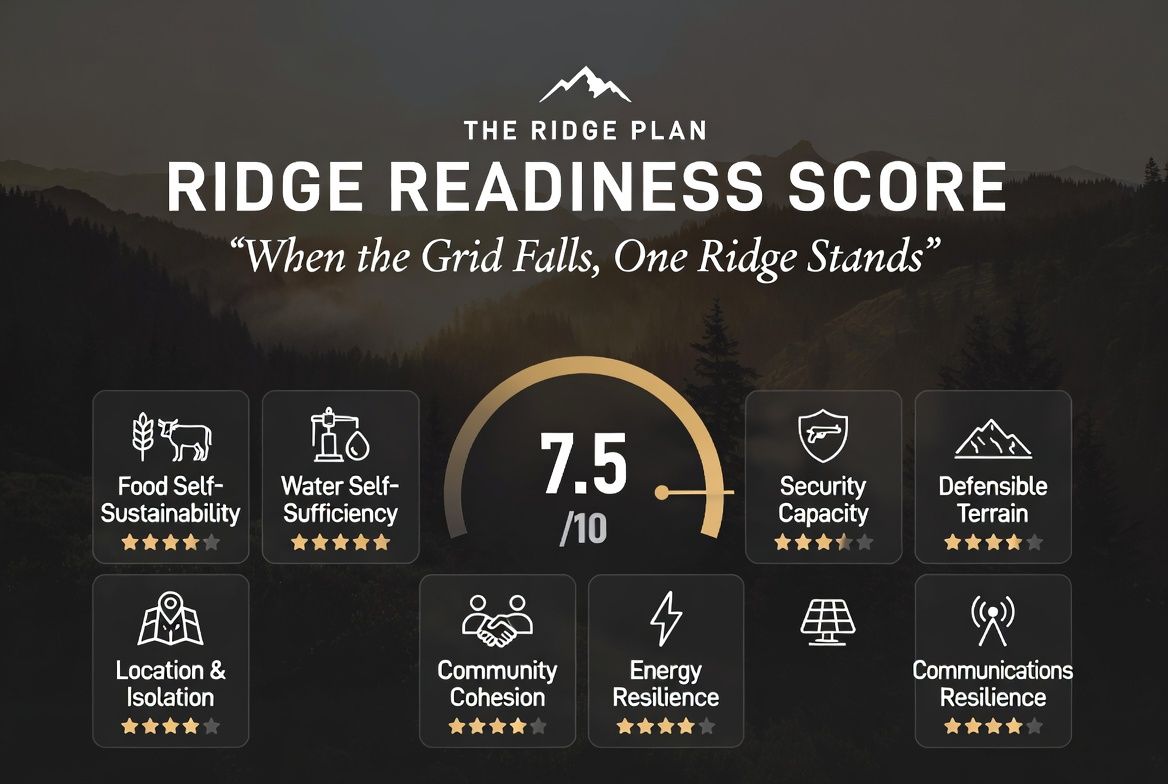
A practical framework for evaluating community resilience when systems fail
Today I’m announcing the development of **the Ridge Score** — a structured way to evaluate how well a county or community can stand on its own when the grid goes down and normal systems stop working.
The idea grew out of a simple question: if everything we take for granted disappeared tomorrow, which places would actually hold? Not in theory, but in the practical realities of water, food, security, terrain, and the people who live there.
What the Ridge Score Does
The Ridge Score ranks locations on a 1–10 scale based on eight core factors that matter most in a serious, prolonged disruption. It is designed to cut through vague “this place feels safe” impressions and replace them with a clearer, more consistent evaluation.
It is not a prediction of the future. It is a tool for thinking more clearly about resilience.
Why It Is Needed
Most people evaluate a place by cost of living, schools, or commute times. Those things matter in normal times. They matter far less when the power is out for weeks, the stores are empty, and outside help is slow or nonexistent.
In a grid-down or cascading-failure scenario, the questions change:
- Can people get water without a municipal system?
- Is there meaningful local food production?
- Does the community have the means and mindset to protect itself?
- How easy is it for large numbers of people from nearby population centers to reach the area?
- Does the terrain help or hurt the people trying to hold it?
- Are the neighbors likely to work together or turn on each other?
The Ridge Score exists to force those questions into the open.
The Eight Factors
The current version of the Ridge Score evaluates locations across these eight factors:
- 1.
Water Self-Sufficiency
Independence from municipal water systems and access to reliable private sources.
- 2.
Food Self-Sustainability
Local agricultural capacity and the ability of the community to produce meaningful food without long supply chains.
- 3.
Security Capacity
Firearms prevalence, culture, and the practical ability of residents to defend themselves and their community. - 4.
Defensible Terrain
Natural geographic features that limit approach and favor those holding the ground.
- 5.
Location & Isolation
Distance from major population centers, the size of those centers, and how easily large numbers of people can reach the area. - 6. Community Cohesion & Mutual Aid
- Levels of trust, shared values, and the willingness of residents to organize and support one another under stress.
- 7.
Energy Resilience
Ability to keep critical systems running without the grid. - 8.
Communications Resilience
Capacity to communicate when cell networks and the internet are unavailable.
These factors are weighted according to real-world survival priorities, but the exact weighting model remains proprietary while the system is refined.
Still Under Development
The Ridge Score is a working framework, not a finished product. Scoring criteria continue to be tested against real counties, and the model will evolve with better data and sharper analysis.
I am actively looking for thoughtful feedback. If you see gaps, have suggestions for additional factors, or want to challenge the current structure, I want to hear it. Constructive input is not only welcome — it is needed.
The goal is simple: create a clearer, more honest way to think about what makes a place capable of standing when everything else falls.
More details and the first scored locations will be released as the system matures.
Feedback welcome.