Ham Radio was Never Designed for Anonymity
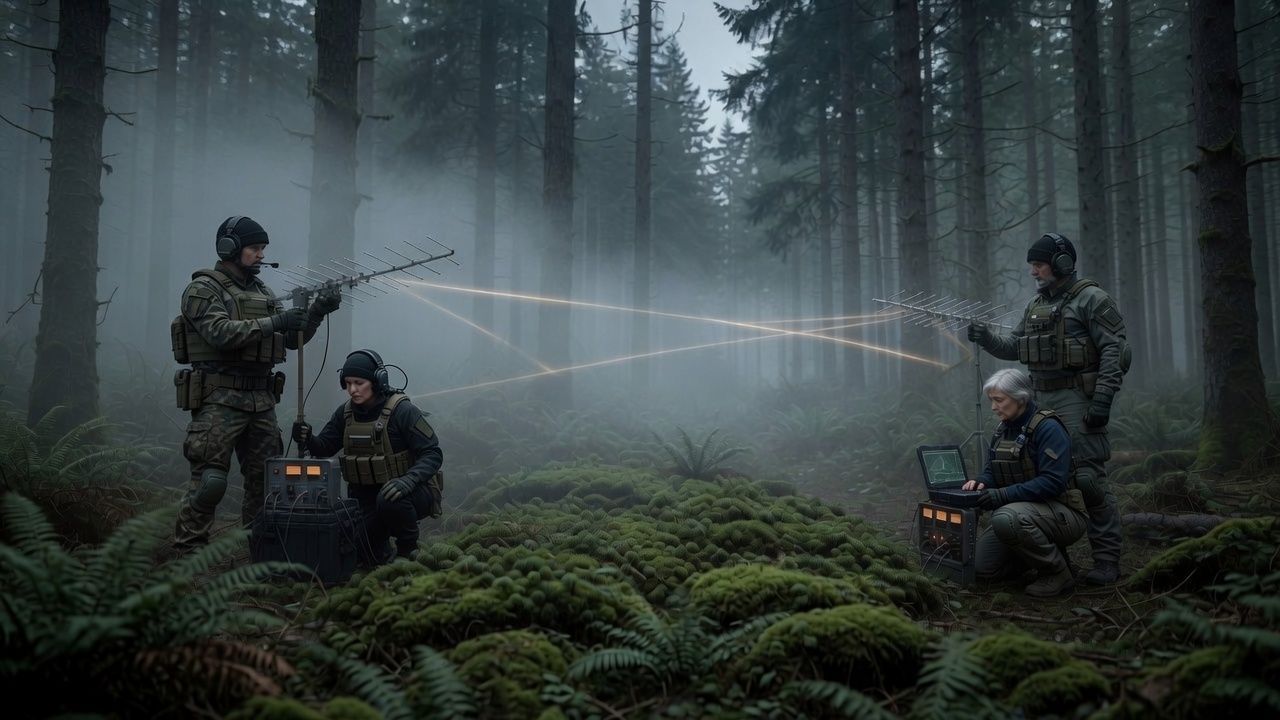
A person transmitting on amateur (ham) radio can often be tracked and, in principle, targeted. This is a well-established technical and regulatory reality, not speculation.
How tracking works
Radio direction finding (RDF), also called foxhunting or transmitter hunting, is a standard technique used by hams, the FCC, search-and-rescue teams, and others. With directional antennas (such as Yagis), signal-strength measurements, and triangulation from multiple points, the source of a transmission can be located—sometimes to within tens of meters on VHF/UHF frequencies under good conditions.
- VHF/UHF (common for local repeaters, simplex, and handhelds) is relatively easy to direction-find because signals are mostly line-of-sight.
- HF (longer-range skywave) is harder due to ionospheric propagation, but still possible with more advanced equipment and multiple stations.
- Higher power, fixed antennas, and continuous transmissions make locating easier; low power, brief transmissions, or mobile operation make it harder.
Amateurs routinely practice this skill recreationally (“fox hunts”) and use it practically to find interference sources or stuck transmitters. Historical examples include wartime efforts to locate clandestine transmitters.
Identification is built in
U.S. (and most international) rules require operators to identify with their assigned call sign at regular intervals. Call signs are public records. In the United States, anyone can look them up in the FCC’s Universal Licensing System (ULS) database and see the licensee’s name and mailing address (operators can use a P.O. box for some privacy, but the association still exists).
Once you hear a call sign, you already have a strong lead on identity and a starting location. Combining that with RDF on the actual transmitter often pins down the operator or station more precisely. Systems like APRS go further by deliberately broadcasting GPS position reports.
“Targeted”
“Tracked” is technical and routine. “Targeted” depends on context and intent:
• Lawful monitoring, enforcement against illegal operation, or finding interference is common and expected.
• In adversarial situations (hostile actors, wartime, or criminal interference), radio emitters have long been located and acted against.
• For ordinary, legal, licensed operation, physical targeting is rare—most hams operate openly and the hobby is self-policing—but the technical capability exists for anyone with the equipment, skill, and motive.
Ham radio was never designed for anonymity. Transmissions are inherently detectable, direction-finding is a core skill of the hobby, and license data is public. That combination makes tracking (and potential targeting) feasible in ways that differ from more private communication methods.